The habit of helping others

One of my Grade 9 students, still learning English, wrote this in an essay:

Helping others are also very easy. You can volunteer only one minute to others. For example, pick up rubbish, five seconds. Wait in the elevator while people are coming, five seconds. You can only use a minute to help others. Then, you will have a habit, helping others. No one forcing to help others, you get habit, that is the greatest habit in the world.

Couldn’t say it better myself.

The bad habits that kill

Heart attacks just come out of nowhere, right? They happen to anybody, without warning, right?

Wrong. In the vast majority of cases, they are caused by years of bad habits.

MyHealthInsight.com reports on a study published in the Journal of the American Medical Association finding that 90% of the people who suffer heart attacks have high blood pressure, high cholesterol, or diabetes, and/or smoke cigarettes.

In other words, people who are overweight because they eat loads of sugar and fat and processed foods, people who don’t exercise regularly, people who smoke—they are the ones, 9 times out of 10, who have heart attacks.

It’s not just bad luck.

It’s not just luck, either, that some students do well in school and others do poorly. Good habits make good students.

Thanks to The Habit Guy for pointing to this story.

How youth tricks us into developing bad habits

When I was 14 I came home after school and ate enormous amounts of food. I remember eating, for example, an entire half-gallon bucket of vanilla ice cream (more than two litres). Despite this behaviour my tummy stayed slim and I never suffered any ill effects. By the time I was 30, however, the eating habits I acquired in my youth had become toxic, even lethal. My 14-year-old metabolic rate had slowed to a crawl, and all that junk food turned into fat. The habits that worked fine for me as a kid were disastrous for me as an adult.

Something similar happens in school. Does anyone really need to write down homework assignments before Grade 9 or 10? No, not usually. There’s not that much homework, and life is not filled with appointments, meetings, to-do lists, complicated work schedules, and an endless sequence of family obligations.

So as young people we are betrayed into developing bad habits that work fine for us in the short run, but cause us big headaches in the long run.

Do yourself a favour if you’re in Grades 6-9, and try to develop good habits now, not because you need them now, but because you will need them later.

Are you hungry because you’re growing so fast your pants are always too short? Fine: eat! But don’t eat loads of sugar and processed foods. Fill up with whole grains and fruits and vegetables. Drink water, not colas and other sugar-laced beverages.

Are you tempted to skip writing homework assignments in your school agenda or diary because you can remember them just fine—or can ask a classmate later tonight? Write them down anyway, every time, so that using a homework diary becomes as automatic and painless as brushing your teeth. Then when your life becomes really complicated (and it will, I promise!) you will already have one of the most important habits you’ll need to keep everything organized and under control.

Don’t let yourself develop bad habits when you’re young, just because you can get away with them painlessly, because believe me: the pain will come!

Reviews of ‘Good Habits’

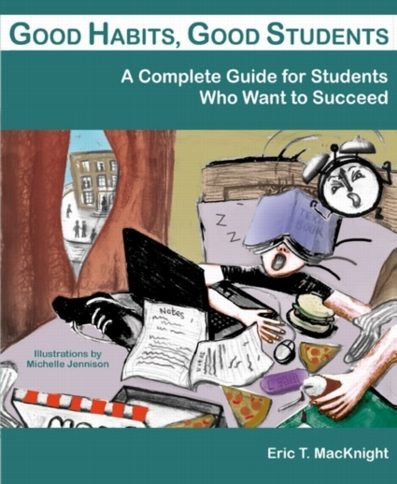
Two educators I greatly respect have written reviews of Good Habits, Good Students and have kindly allowed me to post them here and here.

Caroline Ellwood was one of the founders of the International Baccalaureate’s Middle Years Programme. She has been a middle school teacher and principal, taught IB Theory of Knowledge, and has been a leading proponent of Islamic Studies in international schools. She is currently editor of International Schools and the International Schools Journal, the two flagship publications of the Council of International Schools.

Konrad Glogowski is well known and widely respected for his blog of proximal development, in which he chronicles his work as a middle-school teacher in Canada. If you teach secondary school, have a look: Konrad is sure to challenge and inspire you.

I am grateful to Caroline and Konrad for taking the time to read Good Habits, and very pleased that they have positive things to say about it.

Free Sample Copies for Review

I now have some copies of Good Habits, Good Students that I can send out to anyone who might be able to write a review, share it with colleagues, consider it for adoption as a textbook, or purchase multiple copies for classroom use.

If you are a

  • book reviewer
  • educational blogger
  • magazine editor
  • teacher
  • school administrator, or
  • professor in a school of education

I will happily send you a copy on request. Just drop me an email message [ericmacknight AT mac DOT com] explaining who you are. Be sure to include your mailing address. I will send your copy off as soon as I can.

Offer good, as they say, while supplies last.

UPDATE 22 OCTOBER 2007: Sorry, but I’ve run out of sample copies. I will order more and let you know when they have arrived via a new post. In the meantime, consider buying a single copy from your favourite online bookseller.

Practice good exam-taking strategies [book excerpt]

It’s that time: end-of-year exams have either started already or will shortly. This excerpt from Good Habits, Good Students may help.

Getting Started
Read the instructions and skim all the questions of the whole exam before answering any questions. Be sure no pages are missing from the exam booklet. Be sure whether you should write your answers on the question sheet or on a separate answer sheet. Should you write in pen or pencil? Put your name on the exam booklet and on every one of the answer sheets. Use a highlighting pen to mark important information in the instructions or questions. If a question is unclear, write a note to the teacher explaining how you have interpreted it.

Comprehension Questions
Read the questions first and then the passage they’re based on. That way, you know what to look for when you read the passage.

Multiple-Choice Questions
If you aren’t sure, test researchers say your first hunch is more likely to be correct.

Know how much each question or section is worth, and spend most of your time on the most valuable questions.

Don’t get stuck on a difficult question. Skip it, answer the questions you know, and then come back to the difficult ones at the end if you have time.

Essays
Before you begin writing, brainstorm your ideas (web diagrams or mind-maps are excellent) and then plan out the structure of your essay.

State your thesis in the first paragraph.

Be sure that each body paragraph consists of one assertion plus all the evidence and argument needed to support it. Lead your reader smoothly from one paragraph to the next with transitions or linking phrases that reinforce the meaning of your argument.

In the conclusion, try to do more than simply re-state what you’ve already said. Take your ideas “one step further”  by discussing the wider implications or adding your personal judgments.

If you have time, catch your reader’s interest by opening the essay with a startling statement, a quotation, or a brief anecdote. Then in your conclusion you can close nicely with a da capo (“from the top”) ending that returns to your opening by commenting on it, completing it, or adding to it.

Mathematics and Science Tests
Show all your work. Be sure your reasoning is clearly explained, as this is often just as important as the final answer. Never delete or cancel a solution until you have discovered a better one. We learn a great deal from our mistakes, and teachers will be able to help you make improvements if they can see your mistakes and understand where you’re making a wrong turn.

If you finish the test or exam early . . .
There are three possibilities: a) the test was too easy for you; b) the test was too hard for you; or c) your answers have been too hasty and careless. First, re-read the entire exam—questions and answers—making any needed changes or additions. Second, re-read it again, starting with the last question and working your way back to the beginning. Why? Reading it backward may help you catch a mistake you missed before. Finally, read through your answers to check for spelling and grammatical mistakes.

The Homework Workout: exercise your mind and your body

“The experts” say you should take a short break every 20-30 minutes when doing homework. They also say you should exercise regularly. Teachers say the assignment is due tomorrow and if you don’t hand it in . . . .

What to do?

Enter the Homework Workout.

Set the timer for 20-30 minutes and start in on the homework. When the timer goes off, do a set of pushups, say, and a set of squats. Don’t forget to stretch. Reset the timer, and go back to the books. When the timer goes off again, do another set of each exercise. Don’t forget to stretch.

The Homework Workout will keep your mind fresh and alert, your muscles toned, and your homework assignments up to date.

You can do lots of exercises right in your bedroom or study: pushups, squats, ab crunches . . . try some isometrics, too. If you do yoga, try a few sun salutations. If you have weights, do some curls or overhead lifts.

You’ll end up in great shape, and so will your grades.

(Don’t forget to stretch.)

Arrive on time (book excerpt)

It’s a matter of respect.

In some schools, arriving late to class is viewed seriously, with strict rules, late slips, detentions, and other penalties for those who are tardy too often. In other schools, these issues don’t seem so important. Most students attend 6-8 classes each day, along with occasional assemblies, meetings, rehearsals, and practices. It’s a busy life, but it’s also often repetitive. If your school doesn’t stress the importance of arriving on time, it’s easy to slip into the bad habit of thinking it’s not really important.

However, in the real world, arriving on time can be very important. Some cultures value punctuality more than others, but in those cultures where it’s important, arriving late can be a serious problem. What’s the big deal about arriving late? It’s a sign of disrespect. A student who arrives late to class is sending a message to the teacher: “You and your class are not very important to me, and making you and the rest of the class wait for me or disrupting the class by entering late is really not a problem, because you and my classmates are much less important than I am.”

Later in life you’ll be happy to have the habit of arriving on time when you have to get to work each day, attend business meetings, make appointments with doctors, lawyers, and bank officers, etc. Arriving on time for dates can be important, too. In each case, by arriving on time you send the message that you respect others and appreciate the value of their time and attention.

If you are in the habit of arriving late, start arriving on time today.

Four Ways Teachers Can Inspire Students

[Note: This was written before revelations about Bill Cosby’s personal behavior made him someone whose words one would hesitate to quote, even if the words themselves are exactly right.]

As I have written before, a teacher’s first job is to inspire students to learn. Konrad Glogowski has written along similar lines about “passion-based learning,” and my Grade 8 students recently read his article and added their own thoughts on their class blog.

Reading their posts, I find some common threads about what teachers can do to inspire their students.

1. Be passionate yourself, and share your passion with your students. Most of my students agree that an uninspired teacher will not inspire students. “I believe that teachers being passionate in teaching is the key to everything,” writes a Grade 8 girl.

2. Explain why. Repeatedly my students say that when they don’t understand the point of an activity or lesson, they lose interest. History lessons seem to be a particular problem (“Who wants to learn history? The stuff in the past doesn’t matter anymore. What does matter instead is the future.”) but any topic can seem irrelevant if its relevance is never explained. By chance I came across an article in Teacher Magazine in which comedian Bill Cosby is interviewed on exactly this subject. Cosby tells about a speaking engagement in which he discovered that one of the panel members was a math teacher.

I said, “Perfect. I’ll be the kid.” He looks at me. I said, “You’re the teacher.”

I looked at him and I said, “Why I gotta know this?” And he stared back at me. I said, “You teach algebra?” He said yes. I said, “Why I gotta know this?”

I turned to [the audience] and I said, “If you can’t out-argue a kid about your passion, the discipline you’re in, then you might as well take the job, put it down, and go on over to the post office. You’ve got to be able to tell these children the beauty of your passion.”

3. Teach for understanding. If students find a topic boring, 9 times out of 10 they don’t understand it. “Whenever you stop understanding things, you also lose interest . . . .” (On the other hand, if the teacher finds it boring, we have a different problem altogether. See #1, above.)

4. Be supportive, kind, and open. Primary school teachers understand this. Unfortunately, too many secondary school teachers seem to think their first commitment is to the curriculum, not the students. They forget, too, that even though adolescents try to act older than they are, they still respond very well to kindness, and very poorly to its absence. (Who doesn’t, in fact?) Listen to what my students say.

•“I didn’t have to think, Boy, that was a stupid question. . . . The way she taught was really helpful.”

•[When students] “hate the subject and the teacher . . . there won’t be any deep thinking, creative ideas, or enthusiastic debating in class.”

•“There is a teacher that once made English my favourite subject. . . . She was never annoyed at students asking questions and [having to] repeat the explanations over and over. . . . She paid attention to every single student, and thought about our projects together. Since she was an easy person to talk to, many students asked for further advice and guidance. She also constantly encouraged us, and she shared many stories and ideas with us.”

•“Most of the time, I hate the subjects, because I don’t really like the teacher who is teaching it.”

•“Teachers also have to be supportive and kind to all students so that students feel comfortable about talking to teachers about their passions and asking questions about them.”

Students clearly understand the importance of teachers being kind and open, and cultivating positive relationships with students. I wish every teacher understood this, too.